
Grief is like that universally disliked aunt in the family whom nobody ever invited, and yet she showed up anyway — with a suitcase full of regrets, reproaches, and complaints. She made herself at home in the living room, and soon enough in the whole house, because you literally keep tripping over the aunt and the things she has strewn everywhere. Let us add that the aunt is constantly crying, lamenting, and generally unbearable. She was supposed to stay for a few weeks, a few months, a year at most — and yet the year has passed, and the aunt has no intention of leaving. She sits there as if nothing were wrong, sniffing apathetically, knitting a grey, miserable sock. As if she intended to stay here. Forever. “This is enough,” you think. At first awkwardly, but still politely, you try to make the aunt understand that it is time to go back to her own home. The aunt does not hear you, or pretends not to hear you, and keeps knitting her sock. A stab of anger makes you add, a little sharply, that everyone needs “space.” To which the aunt, without lifting her eyes from her knitting, cheerfully replies that your living room is spacious enough for her. And when you finally lose your temper and tell her to pack her things at once, the aunt slowly gets up and, with wounded dignity, rolls up her sock. She walks out, shuffling in her slippers. “At last,” you think with relief, but also with a certain embarrassment that it took such a scene for the aunt finally to decide to leave. Yet you soon realise that the aunt has not gone far at all — she has only gone to the kitchen to brew herself some calming herbs. No, no, you will not get rid of her that easily…
Living with grief feels to me exactly like living with that impossible aunt. She spoils my best moments, stirs a spoonful of tar into a jar of honey, refuses to let herself be forgotten. Meanwhile, the world rushes ahead as if nothing had happened, everyone long having forgotten the “small family tragedy,” absorbed in their own affairs — and it seems that I am the only one standing still. I feel as though I have been left alone with my sadness and with a grief no one else is able to understand…
As Janine Kwoh writes in her book Welcome to the Grief Club: “I often talk about grief as the most isolating experience — despite it being one of the most universal experiences.” In this one sentence, the writer aptly sums up contemporary culture, in which grief has essentially become taboo, a private or even shameful matter, something one simply ought not mention in company. The “mourning period” is basically limited to funeral preparations and attendance at the ceremony. And while during that time we may still expect expressions of sympathy and signs of support from extended relatives, acquaintances, and friends — after a month or two, silence falls. No one asks how you are anymore, or how you are coping. The person who died is hardly spoken of at all, even at the family table — perhaps in one sentence only, followed by an awkward silence. A neighbour quickly changes the subject, throws in a trivial joke to break the grave mood — anything, as long as no one has to talk about death. Perhaps sometimes you want to remember, to bring back a tender or maybe painful memory, to share it with someone, but very quickly you sweep those thoughts and feelings under the rug. Sometimes someone asks, “When did they die?” and when they hear it was 2, 3, 5, or 8 years ago, surprise appears on their face, as if they wanted to add: “And you are still not over it?”
And the truth is that grief never really leaves — even if it is not on our minds every day. Sometimes a particular sight, a smell, sometimes a specific date in the calendar brings back the shadow of a mother, sister, grandmother, father, uncle, or child who has died. That rupture left by someone important in our small, private universe cannot simply be erased, patched up, covered over with the sticking plaster of a “kind” word, or dismissed by telling ourselves that it is all behind us now, that everything will be fine. Sometimes holidays that used to be joyful become unbearable torture, because that one face is missing from the table…
So what can we do when grief weighs us down with all its heaviness, when we feel alienated, or when it seems as if our world is on fire — and no one outside notices? The remedy, as Janine Kwoh writes, is community: a community of grieving people that slips beyond the boundaries of any one nation, race, or belief system. So let us be present. Let us not judge too quickly. Let us be gentle with ourselves and with others. Let us remember that everyone experiences grief in their own unique way. That it may contain a whole spectrum of emotions, from despair, apathy, dejection, fear, and bitterness, to relief, hope, and cautious optimism about the future. One person may avoid people, while another seeks contact; one may weep endlessly, another may not cry at all, yet still be just as immersed in sorrow and in memories of happier days gone by. One person may need stability and find comfort in familiar daily rituals, while another may need radical change: a new job, a move, or at least a new haircut or hair colour. Each of these different ways of grieving is all right. What matters is that we choose in accordance with ourselves, not under the pressure of someone else’s expectations. In the same way, the length of grief should depend only on us and arise from our natural need. Grieving is not a linear act; periods of intensified sadness and longing may alternate with periods of acceptance and happiness — and that, too, is all right.
Let us not fight grief, because it cannot be defeated. Yet there is hope that if we allow ourselves (and others) simply to grieve, if we allow it to stay within us and alongside us, with the full range of emotions that comes with it — then we may, in some measure, tame it. Perhaps we will finally free ourselves from the burden of our own and others’ expectations about what grief should look like, and allow it simply to be. Perhaps then it will feel a little lighter.
In a difficult situation, in the face of long-term grief such as mine, humour can sometimes help. I will tell you that I have made a certain peace with my grumpy aunt, the one nobody invited. I still do not like her. I would rather she had never come to me at all. And yet after reading The Grief Club, I understand now that this grumpy aunt, whom some call grief, is also something I need in life, and that she has her own role to play.
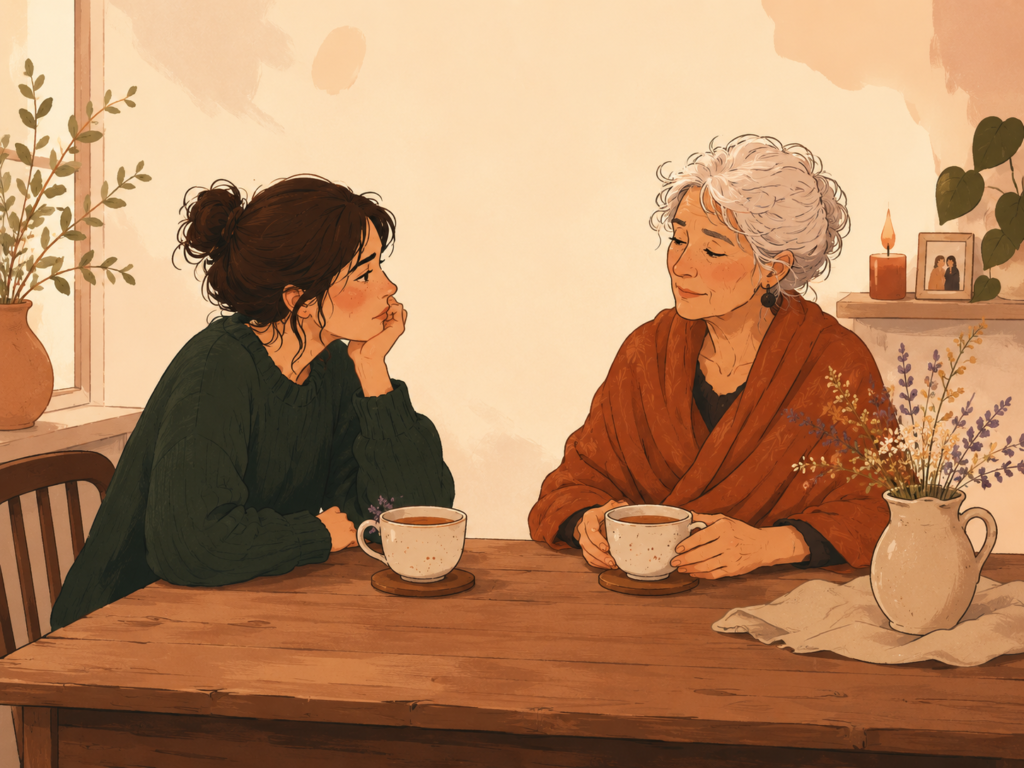
I sigh. I get up. I walk into the kitchen — I will have a cup of herbal tea with my aunt…
Warsaw, June 14, 2026
* Text inspired by Janine Kwoh’s book "Welcome to the Grief Club"
Anita Pachucka, columnist